


Using Pictures
This simple tool can be a powerful catalyst for change. I learned it from Chris Bull when he was with Sheppard Moscow Associates.
When to use it
“Pictures” are best used when the client (an individual or small team) must think about creating change. The client may seek direction in work, life, or a specific problem.
How to use it
Principles
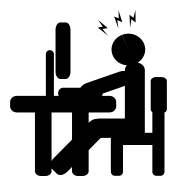
You ask the client to draw a picture of how they see their situation now. They then label this with a phrase (often a Verb (modifier) Noun) that describes what is happening. An example could be “Struggling Alone” when they are working frantically.
The client then draws another picture that describes how they would like things to be in the future. They label the desired process as a verb and a noun (say) “Achieving Calmly”.
Finally, you help the client choose the change process that will help them change things from the present to the future they want. Their method might be “Asking for Help”.
Benefits
People usually feel much better when they become aware of the present situation and why it is frustrating. This clarity gives them something to tackle. Building a vision for the future energises them. It is even better in a group when people share the same dreams. The strategic direction can inform and give life to all the work a person does. Old issues get confronted and solved.
Practical tips
- People are often shy about drawing and worried about having to perform. Be light and gently supportive. Some people will not draw under any circumstances. Help them answer the same questions by interviewing or writing words and phrases on a chart.
- Encourage people to draw freely and not get too formal with structures and organisation charts. Ask the client to explain the picture while you listen and explore their feelings.
- Notice the energy behind their description of the process. Be patient and wait until the client has something that means something to them.
- Ask people for verbs and nouns to describe what they must do to change things from the ‘now’ to the future process. Boil these down by voting, “Which three verbs and nouns appeal to you most?” Then, distil these to find a strategic direction with vitality.
- Encourage the client to use this direction as a metaphor to inform their work or life in the future. Ask, “What does this mean to you? How can you use it with your boss, colleagues, customers, etc.?”
Here is an example of the “pictures” method.
(These pictures are from a clip-art collection. The images, feelings and ideas are essential, not the art.) In an actual situation, people will draw “stick people”.
The preferred future state
“Achieving Calmly”

The present state
Struggling Alone
Then, ask the client to develop a strategic direction (a short phrase) to move from “now” to the preferred “future”. In this instance, the direction is “Asking for help.”. Then ask, “What does it mean, and what will you do?”
I usually use A4 paper in a one-to-one setting and flip chart paper (or the electronic equivalent) in a group. In the latter case, I encourage shared working at all stages.